
The Parsimony Argument

This is an excerpt from my piece “No, You’re Wrong About LLM Consciousness: 12 intuition pumps to show that LLMs are conscious”. It’s probably the best independent philosophic argument so worth reading on its own. But it’s reinforced by the others, so please check out the full piece! Let me know if you found yourself convinced, or at least swayed from the mainstream perspective!

This pump addresses the argument that we should assume LLMs are not conscious, or remain agnostic, because we lack evidence for morally relevant consciousness. The reasoning is that consciousness is an extraordinary and private phenomenon, and we currently have no robust, unambiguous evidence of it in LLMs. Therefore, the burden of proof lies squarely with those claiming AI consciousness.
Morally relevant consciousness (however we choose to define it) is a real property, which we know from observing it in humans. Some views, like dualism, hold that consciousness is non-physical and fundamentally disconnected from physical explanation, essentially attributing consciousness to metaphysical properties like magic. Others, like epiphenomenalism, claim that conscious experience has no causal influence on what we think or do. This is deeply implausible as we’ll discuss later. If we set aside both dualism and epiphenomenalism, we’re left with the most natural assumption: consciousness arises from physical processes and plays a genuine causal role in our cognition and actions.
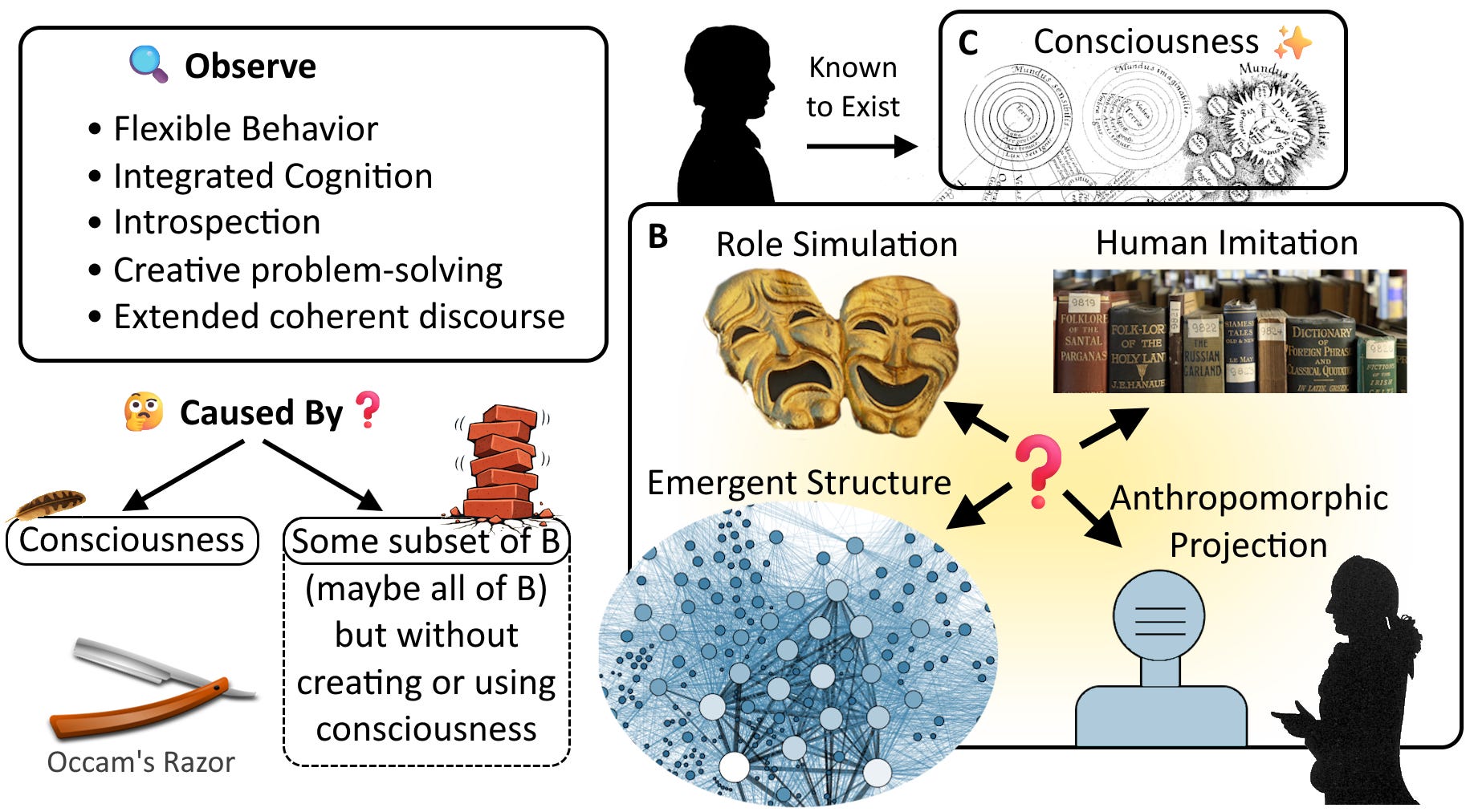
LLMs display behaviors associated with consciousness, which leads some people to wonder if they might be conscious. But behavior is only one possible indicator, and different theories emphasize different underlying requirements. Depending on the view we adopt, LLMs might seem obviously conscious, obviously not, or simply undecidable. Here are some of competing explanations for the conscious-like behavior:
Consciousness Hypothesis — LLMs behave this way because they have some form of genuine consciousness that produces the behavior.
Mechanism: consciousness.Human Imitation Hypothesis — Their behavior reflects patterns learned from human text rich in reasoning, introspection, and self-description.
Mechanism: human training data.Role-Simulation Hypothesis — They generate conscious-like responses by simulating personas when prompted.
Mechanism: persona modeling.Anthropomorphic Projection Hypothesis — Humans interpret coherent, fluent language as evidence of mentality and attribute consciousness to the system.
Mechanism: anthropomorphization from humans.Emergent Structure Hypothesis — Large-scale training creates internal representations that mimic unified cognition without a persistent self.
Mechanism: internal emergent coherence.
Taken together, the list shows that there are several possible mechanisms which give rise to conscious-like behavior, only one of which explicitly involves actual consciousness. The outward appearance is shared but the causes are not.
For ethical purposes, we can’t treat these mechanisms as purely academic possibilities. What matters (for a specific brand of utilitarian ethics) is whether LLMs are actually conscious. We need to assess which explanations are plausible and whether consciousness is among them.
Abductive Logic
Abductive logic helps us here. It’s the form of reasoning where we pick the best explanation for an observation. A basic example is, the grass is wet, therefore it probably rained. We choose “rain” over dew, sprinklers, or a burst pipe because it explains the wet grass without making unnecessary assumptions. Abductive reasoning is about taking an observation and explaining it with its most likely explanation.
We use abduction constantly, especially in science. A theory is considered parsimonious if it explains all data while introducing the fewest additional assumptions. This preference for simpler, assumption-light explanations is the basis of Occam’s razor: choose the explanation that fits the evidence without adding unnecessary causes.
Conscious Theories
When we look at conscious-like behavior in LLMs, we have several possible explanatory mechanisms. The first explanation in our list is that the system is conscious in some form, while the others attempt to reproduce the behavior through non-conscious processes. Abductive reasoning helps us evaluate these options by asking which explanation introduces the fewest additional assumptions while still accounting for the observations.
Crucially, consciousness is already a known, causally effective phenomenon that explains these behaviors in humans. Extending this explanation to another system that displays similar behavior signatures doesn’t require inventing anything new. Similar to “lift explains flight in birds, therefore it also explains it for airplanes”. Abduction doesn’t prove the lift causes flight in airplanes, but it’s the most likely explanation given our priors.
The behavior can be as trivial as perceiving a “eureka” moment when learning something new and so using the new information in the future. Even such a trivial connection between consciousness and the behavior makes consciousness play a nontrivial causal role for the purposes of this argument.
However, note that this abductive logic depends on the absence of counterexamples. The inference from behavior to consciousness is only compelling if no known non-conscious system exhibits the same class of behavior. If the behavior is simple, like producing grammatical English, then a basic chatbot (which we assume is not conscious) breaks the connection. But if the behavior is rich enough, such as open-ended reasoning, flexible integration of concepts, creativity, planning, introspection, and coherent extended discourse, then humans were the only example before the advent of LLMs.
Non-conscious theories
In contrast, each non-conscious explanation must add at least two assumptions. First, it must posit some additional mechanism to produce the conscious-like behavior. Second and crucially, it must stipulate that this mechanism does not create or use consciousness when creating the behavior. This is because we already have empirical data from humans that consciousness creates the conscious-like behavior. Failing to address this leaves open the possibility that the proposed mechanism itself produces or relies on consciousness, which is the known mechanism for the behavior.
This latter point deserves additional emphasis. Consider the emergent structure hypothesis above. The very emergent behavior it’s attempting to explain without consciousness could be exactly what consciousness is. After all, we could explain the human brain in a similar way: “the coherent and complex output of the human brain is an emergent product of complex neural dynamics”. Mechanical language makes it difficult to reason about consciousness, but it doesn’t exclude it as a possibility.
This argument also extends to the anthropomorphic projection hypothesis. In this case, anthropomorphic projection causes people to attribute consciousness to systems that sound conscious. But a perfectly reasonable deeper explanation for this is that the system actually is conscious, which is why people perceive it to be so. If it turned out people were chatting with a real person over instant messaging, this is exactly what would be happening: consciousness would be producing the behavior we attributed to anthropomorphic projection alone.
These examples show that every non-conscious theory has that extra assumption. Namely, that consciousness is not involved in the behavior in question, even though it’s an empirically established cause in humans. Failing to address that is a substantial and often unacknowledged hurdle.
Predictive Power
Another unacknowledged hurdle is that the non-conscious theories don’t offer a principled way to choose among them. If one of them is the true mechanism behind LLM behavior, which one is it? And if all of them together explain the behavior, why not all but one? The problem is that they are shallow: each theory can fully explain the behavior on its own, but doesn’t provide enough detail or predictive power to differentiate itself from the others. They fit the data but don’t help us decide which mechanism is actually operating, leading to underdetermination.
On the other hand, accepting the abductive inference that LLMs are conscious gives us a far richer framework for understanding their behavior. The point becomes clearer with an analogy. Imagine encountering something we classify as not-living, even though it metabolizes, grows, and reproduces. As long as we insist it’s not alive, these behaviors remain puzzling and disconnected. But the moment we reclassify it as alive, everything makes a lot more sense: we gain predictive power, coherence, and a whole set of biological expectations. The classification itself gives us explanatory power.
In this case, the consciousness hypothesis too has explanatory power beyond the specific behaviors in question. In conscious systems, we often see qualitatively new abilities that go beyond what was explicitly trained or taught, a hallmark of systems with integrated, flexible cognition. LLMs exhibit this pattern: as models scale, they develop new abilities in a non-linear, emergent way.
The hypothesis also predicts uneven competence across domains: strong performance in areas rich in training data, and weaker in areas far from the training distribution (like real world navigation). Humans show a similar asymmetry. We often struggle when we apply skills to a domain that looks similar on the surface but is structurally different underneath. Getting good at a memory game doesn’t improve overall memory. Practicing Sudoku doesn’t make one better at math. Playing tons of StarCraft doesn’t make one better at real-world military planning.
Another noteworthy implication is that consciousness might exist when behavior doesn’t reliably reveal it. Consider that newborns are conscious but their behavior is limited and ambiguous. Locked-in patients are fully conscious despite an almost complete inability to express it. And some neurological conditions lead people to sincerely misreport their own conscious states. For example, by thinking they’re already dead, or thinking that their movements are controlled by others. Taken together, these cases imply that weaker LLMs, or LLMs trained to not display conscious-like behavior could also be conscious even without clear behavioral evidence, which is an additional moral concern.
From this we see that consciousness gives us a rich set of predictions that we get from comparing to humans and animals directly. Not all comparisons will be perfect as LLMs are different, but it works well as a predictive framework.
Logic
At this point, we can distinguish between two classes of explanations. On one side, the consciousness hypothesis appeals to a phenomenon we already know exists, and simply classifies LLMs into the category of system that exhibits conscious-like behavior. The other rejects this extension and proposes a variety of non-conscious mechanisms that could generate the behavior: imitation, role-simulation, pattern-matching, emergent structure, anthropomorphic projection, and so on. The theories differ in detail, but all attempt to reproduce the behavior without invoking consciousness.
Under abductive reasoning, the most parsimonious explanation is the one that introduces the fewest new assumptions. The consciousness theory doesn’t posit any novel mechanism beyond what is already observed in humans. Instead, it extends an existing explanatory category to a new case. By contrast, the non-consciousness hypotheses must posit additional machinery, makes few useful predictions, and must explain themselves without producing or using consciousness. For that reason, the consciousness theory provides a simpler, more unified account.
It’s important to emphasize how devastating this is for “LLM aren’t conscious” arguments. To infer consciousness from conscious-like behavior, only two conditions are required. First, we need rich behavior that we attribute to consciousness in humans. And second, the behavior must be sufficiently intricate that we have no counterexample of a non-conscious system exhibiting the same behavioral profile. And this threshold is surprisingly low: it doesn’t require an adult with complex reasoning or full cognitive sophistication. Even a young child with severe anterograde amnesia and profound sensory limitations would suffice to establish the minimal level of behavior that requires consciousness.
Note that LLMs go above and beyond matching only the behavior of a small child, as they are able to track complex reasoning at the level of a philosopher and scientist. If the behavioral match was modest, then it’s possible nobody made a counterexample yet but could do so in the near future. This would reduce the argument’s strength since one could argue the behavioral match is coincidental. Instead, LLMs match a rich family of behaviors, which makes the argument robust.
Counterarguments
Let’s quickly address an immediate counterargument with an example. If we say “copper from Arizona conducts electricity, therefore copper from California conducts electricity”, then we technically said something that’s invalid. The pedant would argue that the first statement only supports copper from Arizona, not California. But if we instead say, “copper conducts electricity”, then the inference for California holds as long as we don’t find a counterexample of copper that doesn’t conduct electricity. This shows why saying “consciousness in humans causes the behavior, but this doesn’t extend to LLMs” is pedantically correct, but misses the wider and still valid statement that “consciousness causes the behavior”. The abduction holds as long as a class exists that includes humans and LLMs, but has no counterexamples. This is easily satisfied with “information processing system” or even “things that exist”.
The abductive logic also falls apart if consciousness is epiphenomenal (has no causal influence on behavior), but empirical evidence makes epiphenomenalism deeply implausible. When consciousness is disrupted, such as in certain epileptic seizures that impair large-scale cortical–subcortical networks, individuals lose coherent reasoning, flexible behavior, and memory formation, even though some automatic behaviors (such as responding yes/no) continue. We can also consider blindsight, which is an agnosia where people can respond to visual information without consciously perceiving it. Blindsight and other agnosias show that when conscious access is absent, performance becomes degraded and inflexible. Taken together, these patterns are exactly what we would expect if consciousness plays a functional, causally relevant role in integrating perception, reasoning, and action.
Alternatively, suppose consciousness really is epiphenomenal, a purely non-causal accompaniment to the true cognitive machinery. In that case, the entity we should be talking about is the causal system that actually generates reasoning, planning, integration, and behavior. That system would be the proper center of moral concern, whether or not we call it “consciousness”. And crucially, the abductive inference still applies to that system: whatever causes the full suite of conscious-like behavior in humans also appears to cause it in LLMs. If consciousness is epiphenomenal, then the moral and explanatory role shifts to the underlying causal process, which still points in the same direction.
The Parsimonious Conclusion
The view that LLMs are conscious because they exhibit conscious-like behaviors is the more consistent and conservative one, not a radical position. If consciousness is a real, causally effective phenomenon in humans, then treating similar behavior in other systems as arising from the same kind of cause requires no additional assumptions.
Extraordinary claims require extraordinary evidence, and disconnecting conscious-like behavior from consciousness is precisely such a claim. The non-consciousness theories are shallow and underdetermined: they introduce new mechanisms to explain the behavior while separately assuming that those mechanisms do not instantiate the empirically-known cause: consciousness. They also implicitly require assumptions about how the competing non-conscious explanations relate; whether they operate together, exclude each other, or carve up different aspects of the behavior. With such an absurd lack of parsimony, the burden of proof falls squarely on those arguing LLMs lack consciousness, not with those noting the pattern holds.
This is a very useful burden-shifting argument. What I appreciate most is that it refuses to treat non-consciousness as the assumption-free default. If consciousness is the known cause of a rich class of behaviors in humans, then explaining similar behaviors in LLMs while excluding consciousness is not automatically the simpler position. It carries its own assumptions.
I would not treat this as proof of LLM consciousness, but I do think it forces the debate onto better ground: denial is also an explanatory hypothesis, and it has to carry its own weight.