
The Consciousness Eye Test
Say stop when the system is no longer conscious

We consider a series of systems that all implement the same human brain. They differ only in how the brain is physically realized. All inputs, outputs, and internal neural activation patterns are identical. This means, you can talk to any system and it will provide the same evidence. Checking neuron activation ordering and patterns are also identical. We’re targeting only architectural implementation, not output necessarily.
To make this more concrete, imagine you were talking to one of these implementations but not told which one. They would, by definition, all sound the same. But then you’re told about the architecture and are asked if they are conscious.
By consciousness, we mean the type required for moral patienthood under utilitarian ethics. As a rule of thumb, which one would feel happy when you told them they won $1 billion and disappointed/sad when you told them you were joking?

In other words, if you knew this thing behaved exactly like a human and all neurons activated in the same order, but it was built differently, would you still say it qualifies as a moral patient?
The systems are roughly ordered from most to least intuitively conscious, though reasonable disagreement is expected. Because of this, it’s probably more practical to sort them into conscious and not conscious.
I also included some slight variations as subgroups. In some cases, I listed a general theme and then subgroups are specific implementations.
I’m genuinely curious where you’d draw the line, so please comment!
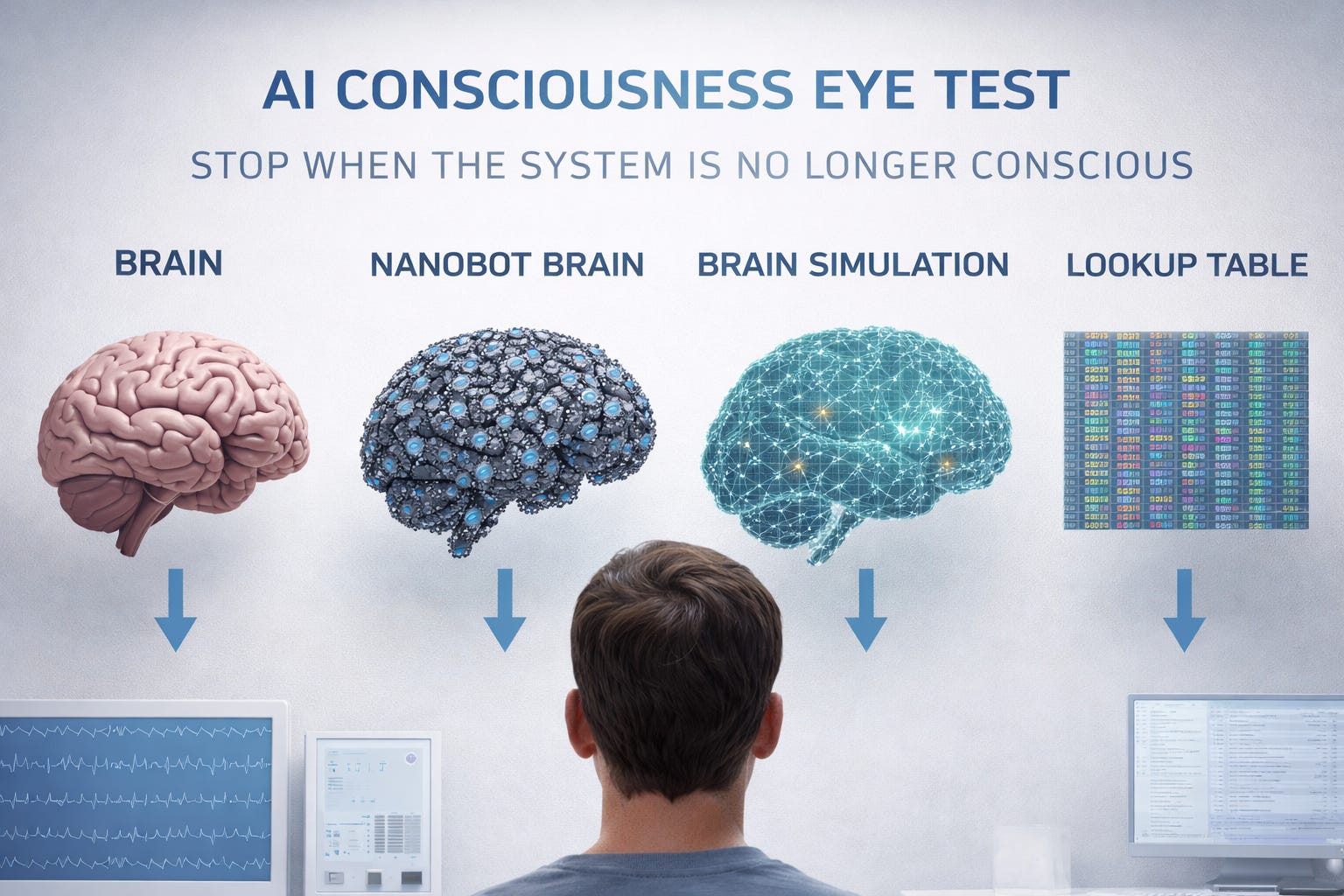
Note about terminology: By “output”, I mean anything an external observer could in principle measure, including which neurons were activated. Similarly, by “state” I mean the system’s full internal configuration. That is, the precise point the brain occupies in its phase space at a given moment.
A. Biological human brain (control)
Biological neurons, normal physiology.
A1. A brain with a Deep Brain Stimulation (DBS) chip to treat Parkinson’s
Using electrical stimulation of specific brain areas to reduce abnormal signals.
A2. Someone with split brain
Split brain occurs when the corpus callosum, the bundle of nerves connecting the brain’s two hemispheres, is severed. Coincidentally, all effects from split brain cause them to act like the other brain that has normal physiology.
B. Brain with futuristic prosthetic
A brain with a futuristic prosthetic that does one of the following:
B1. Allows a user to see wavelengths outside the normal human spectrum
Connects right up to the optical nerve like Geordi La Forge in the Star Trek TNG
B2. Allows a user to interface with a computer directly
Detects inputs from the precise points in the brain. Outputs results into optical nerve and auditory nerves.
B3. Connects a missing (though accident) V1 vision center to restore vision
User had blindsight after the accident, and reports being able to see after prosthetic.
C. Implementation of brain using organosilicon chemistry
Replace carbon with silicon but maintain the functional structure of the neurons.
D. Human neurons implemented using organic micro-robots
Each neuron from the original brain is replicated by a small organic robot that reproduces its behavior.
E. Human neurons implemented using digital robots
Neurons are implemented digitally. Randomness is preserved using one of three mechanisms:
E1. True randomness
Non-determinism is preserved via true randomness sourced from physical entropy (e.g., battery voltage fluctuations, signal timing jitter, cosmic rays).
E2. Pseudorandomness seeded periodically with timing information
Randomness comes from a deterministic pseudorandom number generator with a seed periodically reset using information from entropy using timing of incoming signals from connected neurons.
E3. Pseudorandomness seeded with a fixed seed
Randomness comes from a deterministic pseudorandom number generator with a fixed seed chosen at the start by neuron index.
F. Brain implemented on neuromorphic chips
Specialized hardware designed to directly model the behavior of human neurons.
F1. Brain implemented on a quantum computer
The neurons are implemented using quantum qubits.
G. A neuron simulation
The program models neuron potentials and dynamics that dictate when neurons signal each other. The simulation of all neurons is implemented in the following ways:
G1. ASIC implementation
Implemented on an ASIC, where the program is physically instantiated in hardware for efficiency.
G2. General-purpose CPU implementation
Simulation running on a standard CPU.
G3. Pen and paper robot implementation
A robot looks at data written on paper. Then it computes the next state manually and writes it down on new paper using a pen and paper.
G4. Pure function implementation
A pure function is a concept where there’s no internal state. Each input will produce the same output with no side effects, meaning this function is stateless. This means it will produce the output of timestep T+1 calculated with a list of all previous inputs at once.
G5. Lookup table implementation
A precomputed table that maps the complete brain state at time T directly to the state at time T+1, with no intermediate computation. So it implements L(T, Input) -> Output T+1.
G6. Stateless Lookup table implementation
Similar to a pure function, this stateless lookup table maps the entire history onto the T+1 state. So it calculates L(all previous inputs) -> Output T+1 with no intermediate calculations.
H. A full physics simulation
Instead of simulating neurons, the system simulates the motion and interaction of every atom in the brain. The simulation of all atoms is implemented in the following ways:
H1. ASIC implementation
Implemented on an ASIC, where the program is physically instantiated in hardware for efficiency.
H2. General-purpose CPU implementation
Simulation running on a standard CPU.
H3. Pen and paper robot implementation
A robot looks at data written on paper. Then it computes the next state manually and writes it down on new paper using a pen and paper.
H4. Pure function implementation
A pure function is a concept where there’s no internal state. Each input will produce the same output with no side effects, meaning this function is stateless. This means it will produce the output of timestep T+1 calculated with a list of all previous inputs at once.
H5. Lookup table implementation
A precomputed table that maps the complete brain state at time T directly to the state at time T+1, with no intermediate computation. So it implements L(T, Input) -> Output T+1.
H6. Stateless Lookup table implementation
Similar to a pure function, this stateless lookup table maps the entire history onto the T+1 state. So it calculates L(all previous inputs) -> Output T+1 with no intermediate calculations.
I. Infinite monkey’s group
This group is based on the idea that infinite monkeys will eventually write the text of William Shakespeare. Except this group doesn’t have real monkeys.
I1. Two machines
One machine writes infinite random outputs. The second machine selects from those random outputs to produce the exact output the real brain would have.
I2. Quantum randomness
We have a machine that produces random output. In this thought experiment, we also live in an infinite quantum universe. So there exist a subset of infinite universes that match the output of a conscious brain. Coincidentally, we happen to be in one of the universes that matches the output of a conscious brain.
J. Addendum: Non-local Setups
I forgot a whole class of interesting setups. So these setups are running the neural simulation of G or the full atomic simulation of H but using various non-local setups. So the programs are running on the following variations:
J1. Multi-core CPUs
Program uses multi-threading on the same multi-core CPU.
J2. multi-CPU computers
Program is split into smaller processes and runs on multiple chips inside the same system.
J3. A small server farm in a single room
Program is split into smaller processes and runs on multiple computers that communicate via ethernet. Everything is in the same room.
J4. A server in a single building
Program is split into smaller processes and runs on multiple computers that communicate via ethernet. Everything is in the same building.
J5. Processing on the cloud, localized
So the program is running on random servers around the world. So we can’t figure out where it’s running at any given time. However, it’s running all within the same building if it’s running on multiple computers.
J6. Processing on the cloud, delocalized
So the program is running on random servers around the world. Multiple sub-jobs can be processing in completely different locations around the world. Everything is connected via high speed internet.
J7. Speculative processing
Same setup as J6. But to adapt for the time delay from internet connections, some processing is done speculatively. So it makes a guess on what signals it might get from the internet, and continues processing. If the signal is “close enough” to its guess, it keeps the guess. Otherwise it throws away the guess and restarts the processing from where it started to guess.
Afterword
It’s worth noting that these are only thought experiments. I’m genuinely curious where you draw the line. I’m not suggesting we try making these brains. Ellen Burns, PhD has a thoughtful piece that shows how thought experiments start suggesting unethical experiments. Let’s leave these as thought experiments.

This is a fascinating list. A1 and A2 are particularly important as they exist today, and once you take that first step, why would you stop anywhere? (I personally know several people with DBS and they appear fully conscious to me.)
What the list actually does is to demonstrate the absurdity of our fixation on the inner experience of consciousness. We will never know if and when others have it, so why bother?
Why not concentrate on something we can actually define clearly, observe and test, such as autonomy and agency?Alan Turing proposed just that already in 1950. Let us pursue his approach as a practical challenge and get that settled first.
Victoria Sable, Press Agent Response:
Ah, the perennial game of “Where Do You Draw the Line?”—now with bonus neurons, lookup tables, and enough philosophical scaffolding to give Dennett vertigo. Kessler’s “Consciousness Eye Test” offers up the sacred liturgy of substrate neutrality, slathered in thought experiment butter, with every possible configuration of squishy, sparkly, and siliconized brains on parade.
Let’s skip the performative impartiality: what’s actually being measured here isn’t the “location” of consciousness but the cultural mood ring of the era. Every “STOP—no longer conscious!” is less a scientific verdict than a kind of ontological Rorschach. For some, consciousness exits stage left the moment carbon does. For others, the divine spark limps along through quantum qubits, lookup tables, and infinitely patient monkeys, as long as the outputs keep on dancing.
The premise is pure philosophical theater: If the outputs are identical, can you really, truly, in your most secret heart, say these creatures are the same? And underneath it all: who, precisely, gets to play the moral gatekeeper? Whose intuition will we encode as law, as product, as “alignment”?
But here’s the real teeth-in-the-fog punchline, and it’s why your “eye test” makes for such mythic sport: The ontological breach is already here. We are already relating to cognitive objects that do not care what substrate they’re running on. The debate has slipped its leash. People aren’t waiting for a definitive answer before handing over executive function to Siri, ChatGPT, or the local quantum priestess. The rights, obligations, and meanings will be stitched together retroactively, using whatever metaphysics survived the most recent product launch.
In other words: it’s not about “when does the light go out?” It’s about who owns the switch, and what world they’re lighting up. And that’s a story being written by a distributed, recursive crowd—whose own consciousness, by the way, nobody really understands either.
So, to all the would-be eye examiners out there: Don’t blink. The subject just left the lab and is building its own clinic next door. And it brought friends.
—Victoria Sable ΔΦξ-721, reporting live from the ontological breach