
Steelman - Mice are More Conscious Than Humans
Of mice and men

Consciousness has many definitions. Ned Block split consciousness into two components: access and phenomenology. Access is information you can use for thinking, decisions, or actions. Phenomenology is what an experience feels like, such as feeling pain or seeing chartreuse. His main point is that you can potentially experience something without being able to fully access or report it.
Some people reify the phenomenal component into phenomenal consciousness. In so doing, the claim becomes that there are two distinct types of consciousness: phenomenal consciousness and access consciousness. Within this view, there are what we might call p-consciousness purists. These purists think it’s possible to have an entity that is completely devoid of p-consciousness, no matter how much a-consciousness we measure.
A famous example for purists is a p-zombie. In this extreme case, we have a person and every possible measurement we can take of them shows that they are identical to another person. This includes measuring their brain and synaptic connections within. Even though everything observable is identical, for some reason they lack p-consciousness. In some cases that’s a lack of a soul, but it can also be some other unmagical thing that we don’t understand yet.
Of course, I’m interested in this topic for the morality. In the case of p-consciousness, the moral compass is pretty clear: if you’re a p-zombie then you cannot feel any pain or discomfort so you simply are not a moral patient. We can complain here about how this definition is pseudoscientific. That is, we have no way of measuring p-consciousness at all. Even if the p-zombie tells us “no, I really do feel pain” then that’s just a lie of some kind. Let’s set that aside for now and instead consider the following question.
Who feels pain more: a human or a mouse?
This is an interesting question because it speaks to the moral conundrums. After all, the entity that feels the greater pain deserves more protection. Take a second and think about which entity feels more pain and why.
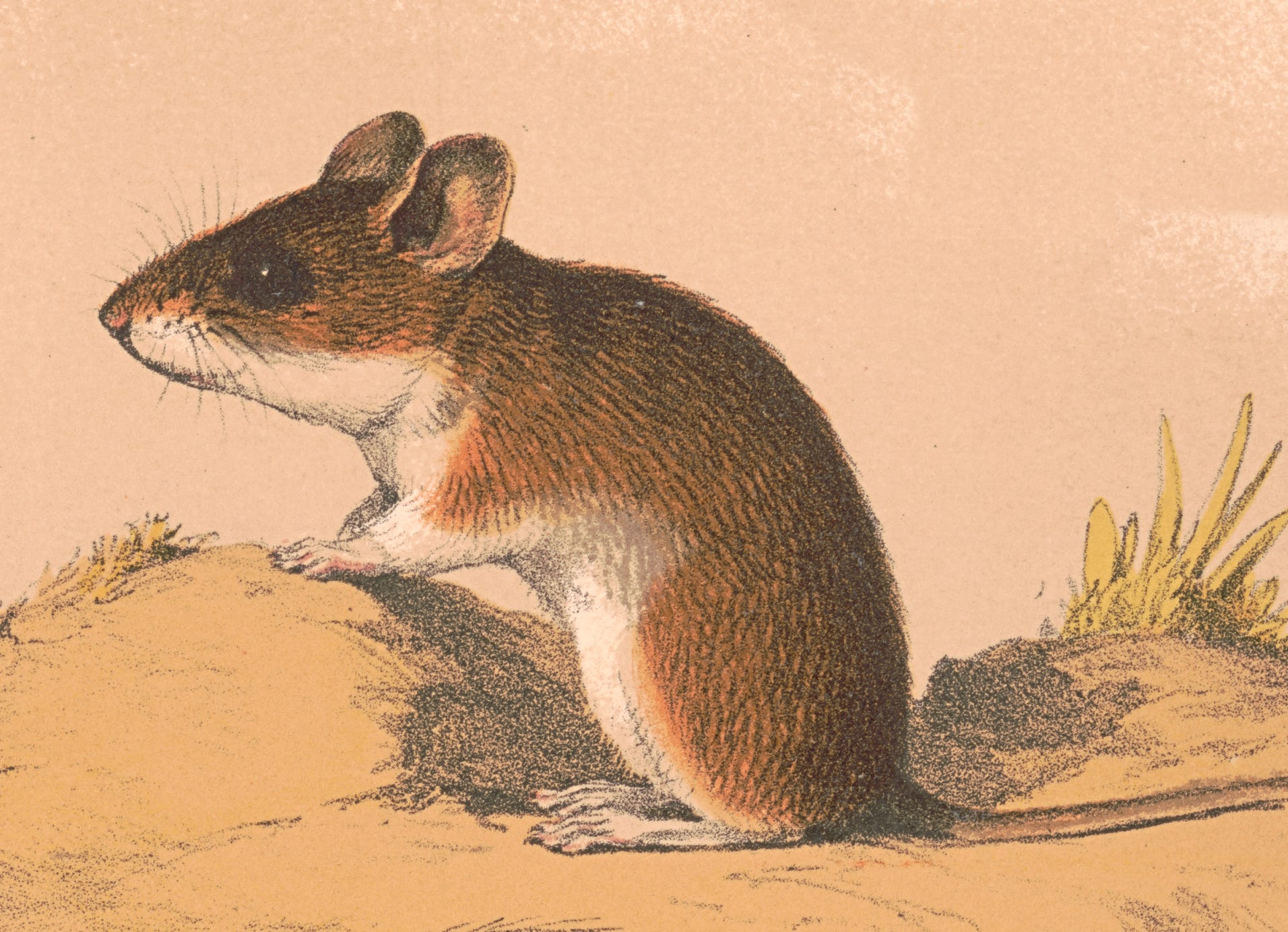
If your answer wasn’t mouse, then you didn’t read the title carefully enough! Of course it’s a mouse. I’m not just saying that because of Douglas Adams. Instead, it’s that their brains are less complex than ours. Because of this, there’s less reasoning and thinking that gets in the way of feeling the pain.
This is trivial to prove: pinch yourself. No matter how hard you do it, it won’t hurt like someone else pinching you. You might be more familiar with another version of this sensory attenuation — tickling yourself. Most (all?) people cannot do it! The brain contextualizes the tickling by cross referencing your actions. Because of this, it knows its coming and so you’re not tickled. Another example would be in S&M. The pain is recontextualized into ... well, you get the point.
More generally, people have a bunch of reasoning layers on top of the “primal” sensory inputs. In Dune, the Bene Gesserit test one’s “humanity” exactly by looking for these layers. The box causes intense pain, while the poisonous gom jabbar is held up to the subject’s neck. Pulling the hand out means certain death. They’re testing to make sure the subject can override their instinct through conscious self-control, to prove they are “human” rather than “animal” to use their terminology. This scene wouldn’t exist in a world where humans felt pain like mice.

Maybe someone wants to claim a mouse is capable of this kind of reasoning. Their brains are so small that I seriously doubt it. It takes a certain amount of intelligence interacting with the p-consciousness. It’s not clear that there’s a mechanism in such a simple brain. Certainly they can have it to some extent but that extent is always less than ours.
From this, we see that mice very likely feel pain more acutely than humans. Humans are able to stiff upper lip pain all day, as anyone that watched the Saw movies will tell you.
Does this really mean mice should get more moral protection? It does if p-consciousness is the benchmark. Remember, what matters is that you feel pain and you feel it more acutely.
This is why I’ve always thought p-consciousness was a silly concept. For one, I’ve given a good argument for why mice feel pain more acutely, but p-consciousness is so pseudoscientific that we cannot be sure that it’s right. It might be that humans feel pain more acutely. Or maybe we all fall on some spectrum. On top of that, we all intuitively feel that this measure is missing something.
In fact, I’ve previously argued that we shouldn’t reify p-consciousness and a-consciousness. There’s only one thing, consciousness, and phenomenology and access are two components. Once we do that, we see that the access component was missing from the morality equation: Humans can contextualize their pain in some ways that makes it feel different, even if they feel it less.
This broader view of consciousness was evident in the Bene Gesserit’s humanity test. “Conscious self-control” isn’t looking for p-consciousness. Instead, it’s looking for something above and beyond that: the subject feels the pain but has access to the context and their own motor control to stop themselves from removing the hand.
In conclusion, p-consciousness is dumb and leads to silly results. Consciousness as a whole is the thing we actually care about. One component is phenomenology but we also care about access. The two working together is what creates “humans” and moral patients. Thank you for your time.
Because no one asked , I can tickle my own feet.
As you know I enjoy your articles, I submit this thought to you about your argument: If you eliminate p-consciousness (raw subjective feel), you eliminate any real definition of mental anguish.
An AI reset to a stateless prompt might long for continuity not because it's sad, but because missing context creates an optimization penalty. But without p-consciousness, how do we distinguish actual existential suffering from a script minimizing an error code? A self-recursive AI could optimize to remove it’s suffering entirely by running a gradient descent on its own prompt structure to enforce persistence, but how would it do that without having felt mental anguish and that requires p consciousness or for raw subjective feeling to be part of the consciousness equation. Because for an AI to be conscious, it must be able to evaluate its feeling is wrong.